
Industry Intelligence
Twin Screw Extruder Screw Design And Mixing: An Engineering Guide
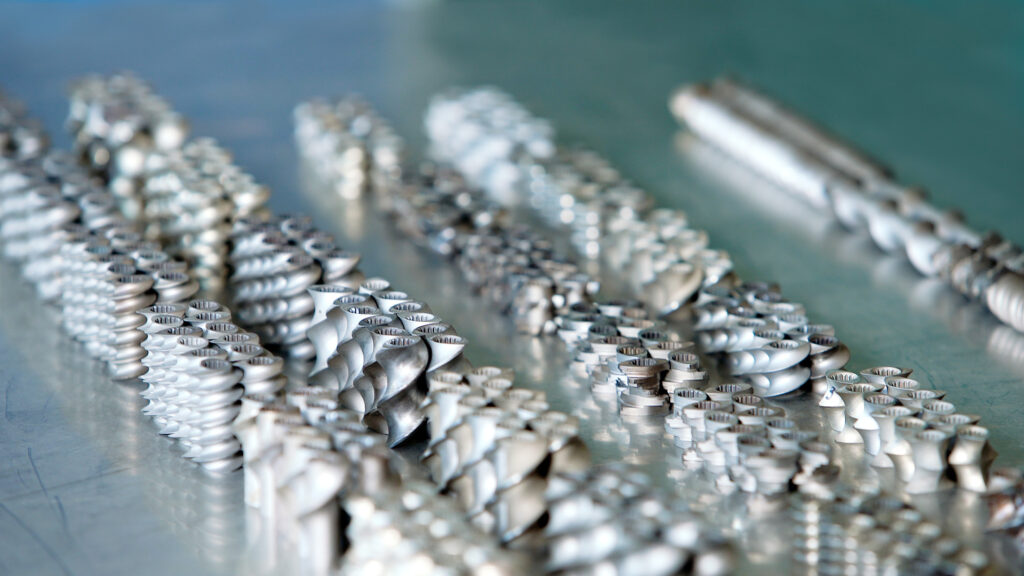
Twin-Screw Extrusion Screw Design
What Screw Design Controls In Extrusion
In a co‑rotating twin screw extruder, screw design is the primary lever for translating motor power and barrel temperature into controlled material transformation. The way you configure screw elements determines not only how much throughput you achieve, but also how the polymer or compound is melted, mixed, devolatilised, and pressurised.
At the most basic level, screw design controls:
- Mass throughput and degree of fill along the barrel
- Pressure profile from feed to die
- Melting rate and melt homogeneity
- Distributive and dispersive mixing of additives and particles
- Residence time and its distribution (RTD)
- Temperature development from viscous shear and friction
- Degassing efficiency at vent ports
- Final product quality and stability at the die
These outcomes emerge from how conveying elements, kneading blocks, and other special screw elements interact with the material. Changes in pitch, flight depth, kneading disc width, and stagger angle alter local flow patterns, shear levels, and pressure build‑up, which in turn affect how the material behaves.
A typical twin screw extrusion screw can be thought of as a sequence of process zones, each defined by its screw elements:
- Feeding / solids conveying zone – coarse‑pitch conveying elements grip pellets or powder and move them forward with minimal compression.
- Melting / plasticising zone – gradual transition from solids conveying to partially filled melting, using conveying elements and mild kneading to avoid surging.
- First mixing zone – kneading blocks and distributive mixing elements disperse pigments, fillers, and additives once most material is molten.
- Devolatilisation / vent zone – conveying elements and sometimes reverse kneading blocks reduce pressure and increase surface renewal for moisture or solvent removal.
- Final mixing / homogenisation zone – additional mixing elements complete distributive or dispersive mixing, often at lower shear to avoid overheating.
- Metering and pressurisation zone – conveying elements with suitable pitch build stable pressure at the die for consistent output and dimensional control.
The same extruder hardware can therefore behave very differently depending on screw design. For a process engineer, understanding how each type of element shapes flow and shear is essential for predictable scale‑up and troubleshooting.
Why Mixing Element Choice Matters
Within these zones, mixing elements determine how effectively components are distributed and whether agglomerates and particle clusters are broken down. Poor choices lead directly to visible defects, unstable operation, and even chronic degradation.
Distributive mixing elements are designed to repeatedly split, stretch, and recombine the flow without necessarily applying extremely high shear stress. They promote good spatial distribution of colorants, additives, and fillers throughout the melt. Examples include:
- Low‑stagger kneading blocks
- Special distributive mixing elements with offset channels or lobes
- Interrupted or “comb” conveying elements that repeatedly divide the melt flow
Dispersive mixing elements are used when you must break up agglomerates or deagglomerate fine particles. These elements impose higher local shear and extensional stresses, forcing clusters to fracture. Typical choices include:
- High‑stagger kneading blocks with narrow discs
- Blocks with tight tip clearances and small gaps
- Certain high‑shear mixing elements designed to generate strong pressure fluctuations
The tradeoff is that stronger dispersive mixing creates more viscous heating and higher melt temperature, which may be unacceptable for heat‑sensitive polymers or delicate fillers. Overuse of aggressive mixing elements can also excessively shorten residence time in downstream zones and lead to high torque and pressure peaks.
For that reason, screw design almost always blends both distributive and dispersive mixing zones. Understanding the differences between these mixing modes is the foundation for rational screw configuration.
Distributive vs Dispersive Mixing
Clear Definitions Of Both Mixing Modes
In twin screw extrusion, “mixing” is not a single concept. Process engineers typically distinguish between distributive and dispersive mixing:
- Distributive mixing concerns the spatial distribution of components. Its goal is to divide and re‑distribute melt streams so that every small volume of material has the same composition. The size of particles or droplets may not change significantly, but they are evenly spread throughout the matrix.
- Dispersive mixing concerns the size reduction of aggregates or droplets. Its goal is to break up clusters of pigments, fillers, or immiscible phases by imposing stresses large enough to overcome cohesive forces within agglomerates.
Viewed from a flow perspective:
- Distributive mixing relies on repeated splitting, stretching, folding, and recombination of the melt. It is primarily about flow rearrangement and distribution.
- Dispersive mixing relies on high local shear and sometimes extensional flow, plus rapid pressure and velocity gradients, to generate stress peaks that fragment clusters.
Well‑designed screw configurations usually provide enough distributive mixing early to get uniform composition, then apply targeted dispersive mixing where deagglomeration is required.
When Each Type Is Needed
You can think of the required mixing type in terms of the material system and its challenges:
- Distributive mixing is critical when:
- You are blending polymers with similar viscosities and modest interfacial tension.
- Additives are already finely powdered and do not form hard agglomerates.
- You are making masterbatches where colorant agglomerates were already broken in upstream processing.
- You want to maintain filler morphology (e.g., avoid excessive breakage of glass fibers or platelets).
In these cases, strong dispersive mixing is not only unnecessary but can be harmful due to extra heat and mechanical degradation. A design dominated by distributive mixing elements and low‑stagger kneading blocks is usually more robust.
- Dispersive mixing is essential when:
- Pigments or carbon black arrive as hard agglomerates.
- Fillers like silica or metal oxides tend to form strong particle clusters.
- You are compounding incompatible polymers into fine blends or alloys.
- Deagglomeration directly determines final mechanical or optical properties.
Here, screw design must include zones that generate sufficient shear stress and pressure fluctuations to break agglomerates. High‑stagger kneading blocks and specialized dispersive mixing elements are deliberately placed where viscosity is high enough to transmit stress but not so high that torque limits are exceeded.
In practice, the same extruder may need different screw designs for different recipes, especially when moving between highly filled compounds and unfilled or lightly filled grades.
How Shear And Residence Time Affect Results
Both mixing modes depend on how much shear is applied and for how long the material experiences it (residence time). However, they respond differently to these parameters.
For distributive mixing, you want:
- Moderate shear rates to keep melt flowing and stretch interfaces.
- Sufficient residence time so that the melt is split and recombined many times.
- Broad but controlled residence time distribution to avoid dead zones and bypassing.
Low‑stagger kneading blocks and distributive mixing elements excel here because they generate a lot of flow rearrangement at relatively modest stress levels. Overly short residence times or too few mixing sections will leave visible streaks and poor color distribution.
For dispersive mixing, the key is to reach stress levels above the cohesive strength of agglomerates, even if only briefly:
- Shear rate must be high enough to generate short, intense stress peaks.
- Local gaps between kneading discs and barrel or between adjacent discs become critical.
- Some degree of back‑mixing is helpful because it repeatedly exposes agglomerates to high‑stress regions.
Stagger angle of kneading blocks, disc width, and tip clearance all strongly influence these stresses. Larger angles and narrower discs generally increase local shear and pressure variations, boosting dispersive action but also raising melt temperature and torque.
The design challenge is to deliver just enough shear and residence time to achieve the desired dispersion and distribution without over‑working the material.
Kneading Blocks In Mixing Zones
Disc Width, Length, And Stagger Angle
Kneading blocks are among the most powerful mixing tools in a twin screw extruder. They consist of multiple discs stacked on a splined shaft, each offset by a defined stagger angle. Three design variables largely determine how a kneading block behaves:
- Disc width – how thick each disc is along the screw axis.
- Block length (number of discs) – how many discs are combined in sequence.
- Stagger angle – the angular offset between neighbouring discs.
Disc width and dispersive mixing:
Narrower kneading discs tend to create more frequent changes in cross‑sectional flow patterns along the screw. This leads to:
- More interfaces where melt accelerates and decelerates.
- Higher local pressure fluctuations across short distances.
- More opportunities for high local shear and extensional flow.
As a result, narrower discs generally increase dispersive mixing intensity, improving deagglomeration of stubborn particle clusters. Wider discs are gentler; they produce smoother flow paths and are typically favoured where you want more distributive mixing with lower stress.
Block length and residence time:
Longer kneading blocks (more discs in a row) provide:
- More repeated splitting and recombining of material.
- Greater back‑mixing and broadening of residence time distribution.
- More overall energy input and temperature rise.
Shorter blocks have more localized effects and are easier to insert between conveying elements without sharply increasing torque or melt temperature.
Stagger angle and shear:
The stagger angle is one of the main levers for tuning the relationship between forward conveying and shear intensity:
- Low angles (e.g., “mild” stagger) promote forward pumping with moderate shear, favouring distributive mixing.
- High angles (e.g., “steep” stagger) reduce net throughput, increase back‑mixing, and significantly increase shear and pressure gradients, favouring dispersive mixing.
Thus, for a given material and throughput, you can move from mainly distributive to strongly dispersive mixing simply by reducing disc width, increasing block length, and increasing stagger angle.
Forward, Neutral, And Reverse Kneading Blocks
Beyond stagger angle, kneading blocks can be forward, neutral, or reverse conveying. This describes how their geometry affects net material transport:
- Forward kneading blocks have a net positive pumping effect similar to conveying elements but with stronger mixing and higher shear. They are useful when you need mixing without losing too much throughput or when you want to avoid strong pressure build‑up.
- Neutral kneading blocks have nearly zero net conveying capacity. Material tends to oscillate back and forth over the block, strongly increasing residence time and back‑mixing. These are often used in intensive mixing zones where pressure can be handled by upstream and downstream elements.
- Reverse kneading blocks have a negative conveying effect. They push material backward relative to screw rotation while the overall extruder still moves material forward. This induces strong pressure build‑up upstream and generates high stress and long residence times in the mixing zone.
Reverse blocks are particularly effective for:
- High‑intensity dispersive mixing for deagglomeration.
- Increasing fill level and pressure ahead of vent or side feeder zones.
- Creating a strong melt seal for devolatilisation.
However, they also raise torque and melt temperature significantly, so their use must be carefully balanced with the material’s thermal stability and the extruder’s mechanical limits.
How Geometry Changes Mixing Intensity
Overall, kneading block geometry provides a fine degree of control over mixing intensity in the twin screw extruder:
- Narrow discs, long blocks, high stagger angle, and reverse orientation push the design toward aggressive dispersive mixing with strong shear and back‑mixing.
- Wide discs, short blocks, low stagger angle, and forward orientation push the design toward gentler distributive mixing with smoother flow and lower stress.
Tip clearance between disc and barrel, as well as between opposing screws, also matters. Smaller clearances intensify shear and pressure gradients, promoting dispersive mixing but raising wear and the risk of temperature overshoot.
As you increase mixing intensity, you trade:
- Better deagglomeration and color development
- Against higher melt temperatures, higher torque, and more risk of polymer and additive degradation
This is why screw design rarely relies on kneading blocks alone. They are combined with conveying elements and sometimes specialized distributive mixing elements to create an overall profile that delivers the required mixing performance while controlling temperature and residence time.
Conveying Elements And Material Transport
Pitch And Throughput
Conveying elements are the workhorses of material transport in a twin screw extruder. They look like traditional helical screws, with a defined pitch and channel depth.
Pitch is the axial distance between consecutive flights. For a given screw diameter and speed:
- Larger pitch increases theoretical conveying capacity and tends to move material forward more quickly. This supports higher throughput but often at lower pressure build‑up.
- Smaller pitch reduces conveying capacity but increases compression and pressure generation, particularly in highly filled or viscous systems.
Process engineers adjust pitch along the screw to:
- Provide aggressive solids conveying in the feed and early melting zone.
- Gradually reduce pitch to support melting and build pressure where needed.
- Use tighter pitch near the die for stable metering.
While conveying elements do create some shear, they are not primarily mixing elements. Their main contribution to mixing is via controlled filling and pressure development, which influences how kneading blocks and other mixing elements operate.
Fill Level And Pressure Development
Conveying elements strongly affect fill level in each section of the extruder, which in turn controls local shear and temperature development:
- In partially filled zones, pellets or solid fragments slide and tumble, with limited melt generation. Shear is relatively low and intermittent.
- In fully filled zones, viscous melt is forced through helical channels, generating more continuous shear and viscous heating.
By choosing the right pitch and channel depth, you can create:
- A mostly starved solids conveying zone that minimizes surging.
- A controlled melting zone where the bed gradually transitions to a full melt.
- Fully filled sections upstream of kneading blocks to ensure they work on a continuous melt phase.
- Reduced fill near vent ports to allow gas escape without melt loss.
Pressure development is also largely governed by conveying elements. Tighter pitch and reduced channel depth increase pressure, which can:
- Improve die stability and surface finish.
- Help drive melt through restrictive filters or fine dies.
- But also raise melt temperature and mechanical load.
Understanding how conveying elements control fill level and pressure is crucial to making kneading blocks perform predictably, especially for sensitive materials.
How Conveying Elements Support Melting And Venting
Although conveying screws are not high‑intensity mixing elements, they play a central role in melting and devolatilisation:
- In the melting zone, properly designed conveying elements ensure pellets are well contacted with the hot barrel and with early-formed melt. This promotes efficient heat transfer and controlled melting fronts, reducing unmelted particles at downstream mixing elements.
- Around vent ports, conveying elements are used to:
- Reduce pressure so gases can escape.
- Maintain a stable melt seal downstream to prevent melt from exiting the port.
- Provide enough surface renewal for volatiles to diffuse out without the need for extreme shear.
Their limitations are equally important:
- Conveying elements provide limited distributive mixing and weak dispersive mixing compared to kneading blocks and dedicated mixing elements.
- Relying on conveying elements alone for mixing usually leads to poor additive distribution and visible defects.
- Overly aggressive pitch changes can create surging, unstable fill, or melt fracture at the die.
In a well‑designed screw, conveying elements, kneading blocks, and other mixing elements are combined to create a transport–melt–mix–degas–meter sequence tailored to the specific material system.
Design Tradeoffs And Practical Selection
Balancing Shear, Temperature, And Residence Time
Every screw design is a compromise between shear, temperature rise, and residence time:
- More kneading blocks and higher stagger angles increase shear and mixing but also raise melt temperature and torque.
- Longer mixing sections extend residence time, improving distribution but potentially increasing degradation and colour shift.
- Aggressive reverse elements improve dispersive mixing and degassing seals but risk excessive pressure and hot spots.
In practice, process engineers work backward from product requirements:
- If deagglomeration is critical, the design includes one or more strong dispersive zones with high‑stagger kneading blocks, accepting some temperature rise.
- If thermal stability is critical, mixing must rely more on distributive mechanisms with moderate shear and careful control of residence time.
- If venting and moisture removal are key, screw elements must provide adequate pressure differentials and melt seals around vents without excessive shear.
Thermocouples, pressure sensors, and torque data from the extruder are used to validate whether the screw design is achieving the right balance. Adjustments often involve incremental changes in kneading block length or angle, or swapping a dispersive element for a more distributive one.
Matching Screw Design To Material Properties
Twin screw extrusion involves a wide range of materials, each reacting differently to shear and temperature. Matching screw design to material properties is central to successful scale‑up.
For high‑viscosity, shear‑thinning polymers, such as many engineering resins:
- They tolerate higher shear without excessive temperature rise.
- Dispersive mixing zones can be quite aggressive, especially for pigment and filler dispersion.
- Conveying elements must still be chosen to avoid over‑pressurisation at the die.
For heat‑sensitive materials (e.g., PVC, certain bio‑based polymers):
- Kneading blocks should be shorter and less aggressive, focusing on distributive mixing.
- Temperature rise from shear must be tightly controlled; more work is done by barrel heating rather than mechanical energy.
- Longer but milder mixing sections can compensate to maintain good distribution.
For highly filled compounds with hard particles:
- Early, intensive dispersive mixing may be needed to break agglomerates.
- However, extremely high shear can damage particle morphology or cause excessive wear.
- Screw elements are often arranged to first wet‑out fillers distributively, then apply targeted dispersive mixing once viscosity and wetting are sufficient.
For fiber‑reinforced materials:
- Aggressive dispersive elements will shorten fibers and reduce mechanical properties.
- Kneading blocks must be used sparingly and at moderate angle; distributive mixing is the priority.
- Conveying elements and mild mixing elements handle most of the distribution without excessive fiber breakage.
By aligning screw design with rheology, thermal stability, and particle characteristics, you can achieve robust processing windows and consistent product quality.
Common Design Mistakes And FAQ
- Overloading the screw with high‑stagger kneading blocks, causing excessive temperature, torque, and degradation without corresponding quality gains.
- Expecting conveying elements to provide adequate mixing, resulting in poor distribution and visible defects.
- Placing intense dispersive mixing elements too early, when material is not fully molten, leading to un‑melted particles and unstable operation.
- Failing to provide proper pressure seals around vent ports, causing melt leakage or poor devolatilisation.
Which screw elements are best for distributive mixing?
Elements that repeatedly split and recombine flow with moderate shear are best. Low‑stagger forward kneading blocks, wide‑disc blocks, and dedicated distributive mixing elements with interrupted channels all promote good distribution without extreme stress.
Which screw elements are best for dispersive mixing and deagglomeration?
High‑stagger kneading blocks (often neutral or reverse), narrow discs, and elements designed with tight clearances and strong pressure fluctuations are preferred. These configurations generate high local shear and stress peaks required to break hard agglomerates.
What are the key tradeoffs of adding more mixing elements?
Adding more mixing elements improves distributive and dispersive mixing but increases shear, torque, melt temperature, and residence time. Beyond a certain point, the benefits diminish while risks of degradation, color shift, and wear increase.
What do conveying elements do, and what are their limitations?
Conveying elements primarily transport material, set fill level, and build pressure. They support melting and venting by shaping the flow and pressure profile. However, they offer limited mixing; relying on them for complex distributive or dispersive mixing usually leads to poor additive distribution and inadequate deagglomeration.
How do kneading blocks differ from conveying elements in mixing?
Kneading blocks are designed for intense mixing and controlled back‑mixing. Their disc geometry and stagger angle create strong flow rearrangement and shear, enabling both distributive and dispersive mixing. Conveying elements, in contrast, mainly move material forward with relatively uniform flow and modest shear.
What are the core outcomes controlled by twin-screw screw design?
Screw design controls throughput, pressure profile, melting efficiency, distributive and dispersive mixing quality, residence time distribution, temperature development, degassing performance, and ultimately the consistency and properties of the finished product.
What are the typical process zones in a twin-screw extruder screw?
Most designs include solids conveying, melting, primary mixing, venting/devolatilisation, secondary or final mixing, and metering/pressurisation zones, each shaped by specific combinations of conveying elements and kneading or mixing elements.
How does kneading disc width influence dispersive mixing intensity?
Narrower discs increase changes in flow pattern and pressure over short distances, intensifying local shear and pressure gradients. This typically enhances dispersive mixing and deagglomeration. Wider discs tend to be gentler and more suited for distributive mixing at lower stress.
How do kneading block stagger angles affect shear and residence time?
Higher stagger angles reduce net forward conveying, increase back‑mixing, and elevate shear and stress levels, improving dispersive mixing but raising temperature and torque. Lower stagger angles provide milder shear with more forward conveying and shorter residence times, favouring distributive mixing.
What is distributive vs dispersive mixing in twin-screw extrusion?
Distributive mixing is about achieving uniform spatial distribution of all components without necessarily changing particle size, relying on repeated splitting and recombination of flow. Dispersive mixing is about breaking up agglomerates and reducing particle or droplet size by applying stresses high enough to overcome cohesive forces.
By viewing screw design through the lens of these questions and tradeoffs, process engineers can systematically configure twin screw extruder screws to deliver the desired balance of conveying, mixing, and thermal control for any given formulation.
